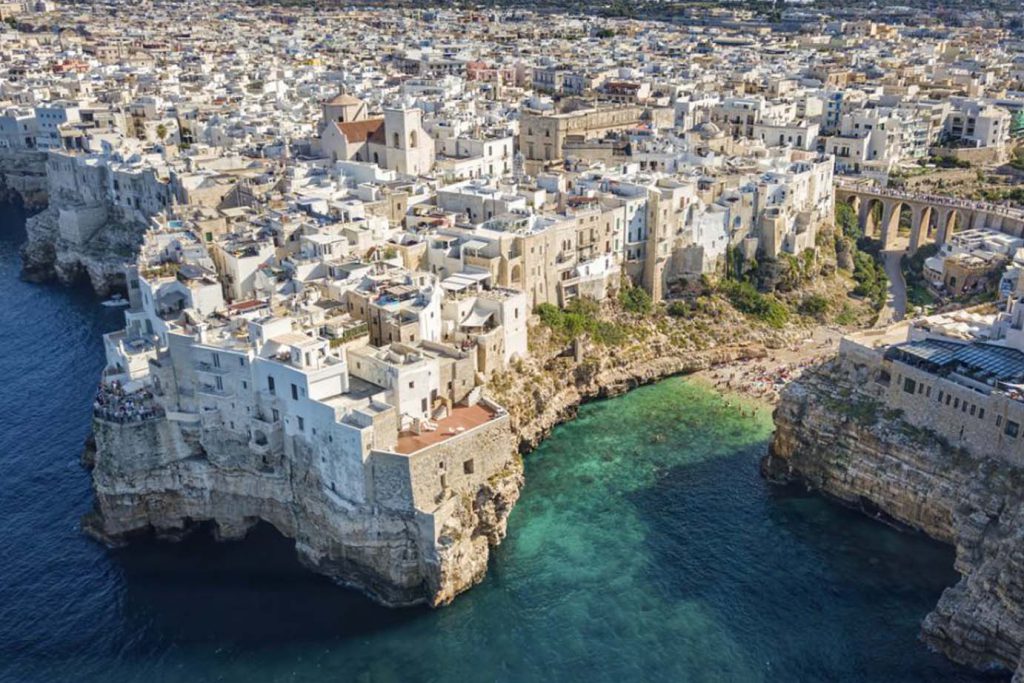
Polignano è la città di Domenico Modugno, conosciuto nel mondo per la sua inconfondibile voce e per quelVolare nel blu dipinto di blu.
Non è un caso se da qualche anno, Polignano è anche la città italiana delRed Bull Cliff Diving, il campionato mondiale di tuffi acrobatici. Un vero e propriovolodi 27 metri, come tuffarsi da un palazzo di 9 piani.

A regular event in the Polignano summer, with thousands of spectators waiting for the highest dives in the world.
A bit of history:
Polignano risale alneolitico, l’ipogeo Manfredi (IV millennio a.C.), è uno degli insediamenti neolitici piùantichi e significatividi Puglia. Nel II millennio a.C., l’approdo degli Iapigi spinse gli abitanti dei villaggi a trasferirsi nella zona dell’attuale centro storico. È anche attestata la frequentazione di questi luoghi da parte dimercanti corinzi e attici, quando la terra di Bari assunse la denominazione di Peucezia.
In the 6th century, Polignano was part of the Byzantine Empire but the town's prestige grew with the arrival of the Normans, thanks also to the work of the Benedictines, present with two monasteries.
The Angevin domination made trade relations with other coastal centers even more intense and many businessmen and merchants, including Venetians, settled permanently in Polignano. The brief Venetian experience of Monopoli in the 16th century will also concern Polignano for about twenty years.
Even today, the Doge's Palace, where the Venetian governor resided, is still present in the historic center. In 1530, Venice ceded Polignano to Charles V, Emperor of Spain. From that moment on, until the Unification of Italy, the dominion was maintained by the Spanish royal family.
What to see:
The mother church dedicated to Santa Maria Assunta overlooks the small Piazza Vittorio Emanuele, the heart of the historic center. It houses works by the sculptor Stefano da Putignano, active between the 16th and 17th centuries, and a polyptych of the Madonna with Child and Saints, from the 15th century on a gilded panel by Bartolomeo Vivarini. Inside the church are kept some relics of San Vito, a fragment of the Arm and the Knee Cap.